
A conversation with Dr Isabel Rimanoczy
SAGES OF THE 21ST CENTURY – S1.E3
What if the biggest barrier to sustainability isn’t policy or technology, but mindset?
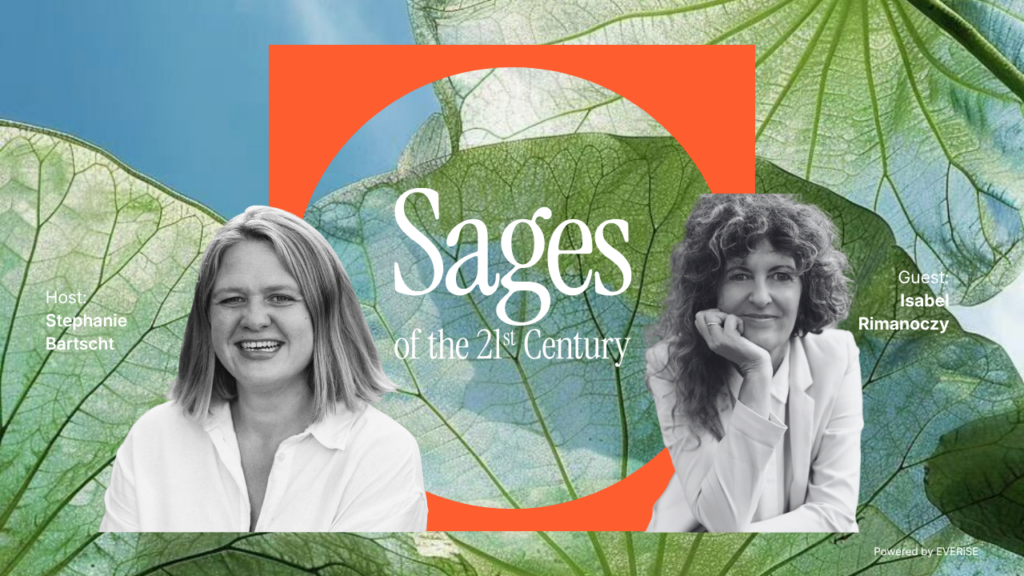
You can listen to this episode on Substack , Youtube and across all major podcast platforms: search for Sages of the 21st Century wherever you get your podcasts, and follow the show to catch future episodes.
A Note from Stephanie
Isabel is a pioneer in so many ways. Her journey with sustainability began totally unintentionally.
While investigating why some leaders strive to leave a positive legacy for her doctoral research, somebody highlighted to her that her work was very related to CSR. This was 20+ years ago. Since then, she has become a pioneer in understanding, exploring, defining, and sharing the ingredients of sustainable practices and behaviours through teaching, books, and the amazing SMI tool (Sustainability Mindset Indicator)
During this episode, Isabel and I dance from sustainability to education, to AI and beach walks– she shares many stories that convey her wisdom and knowledge: an approach that highlights her experience and effectiveness as a coach and teacher. True teaching, Isabel reminds us, is about asking the right questions and sharing stories that magically convey meta messages and leave the listener with an expanded mind. Isabel is a natural at this.
Talking with Isabel is always such a pleasure. I felt so good during this whole chat. Isabel reminds me that a professional life can have many chapters that all belong to the same book. Every step taken grows from the last, and there are many more to be taken. She reminded me I’m not alone with my conviction that sustainability begins in our minds & behaviours, and even though this isn’t the easiest thing to work with, when approached with love, care and patience, it can lead to the most revolutionary change.
With sustainability as the central theme, we talk about what it truly is. For me, so much of the sustainability world is about facts and drama and, dare I say, fear-mongering. Isabel is the opposite. Soft and reassuring, Isabel reminds us/me to focus on the right things: to not get lost in semantics and fear but rather return to the heart and humanness of everyone – remembering that no one really wants to do damage to another and that
95% of our unsustainable behaviours are not intentional.
Meet Dr Isabel Rimanoczy
Dr Isabel Rimanoczy is an educator, coach and author whose work sits at the meeting point of sustainability, learning and the inner life. Isabel created the Sustainability Mindset Indicator (SMI), a comprehensive tool that helps individuals and teams understand the thinking and being that shapes their behaviour. It is built around four pillars: ecological worldview, systems perspective, emotional intelligence, and spiritual intelligence.
Isabel has led a rich personal and professional life. Her journey with sustainability began during her doctoral dissertation at Columbia University and eventually lead to the SMI and a body of work spanning more than 30 books, including Big Bang Being, Stop Teaching, and the fictional Sustainability play: We Need to Talk.
Trained in clinical psychology, Isabel is also a teacher, speaker, artist, and so much more.
She brings a coach’s instinct to everything she does and is less interested in telling people what to think than in asking the questions that open new doors. A convener of a global network spanning 18+ countries of educators embedding the sustainability mindset into business schools worldwide, Isabel describes herself, warmly, as a work in progress.
To find out more about Isabel, visit https://www.isabelrimanoczy.net/who-i-am/
What We Explore in This Episode
This conversation ranges widely, moving between rigorous research and deeply human storytelling. Among the threads Stephanie and Isabel follow:
The origins of the sustainability mindset, and why Isabel’s research began with legacy and caring rather than with policy or the word “sustainability” itself.
Why transformation is almost always personal, how change happens not through neutral data, but when information crosses our internal silos and touches something we care about, creating a cognitive dissonance we feel compelled to resolve.
The four pillars of the Sustainability Mindset Indicator, and the challenge of bringing the softer dimensions – emotional and spiritual intelligence into corporate and boardroom conversations.
The power of alternate vocabularies, such as talking about purpose rather than spiritual intelligence, and the two questions that transform a sceptical room: what is the point of life, and what would you love to do even if it never made you rich?
The shift from teaching to facilitating, why the role of the educator is changing in an AI-shaped world, and what action reflection learning offers instead: solving real problems by connecting learning with doing.
Why 95% of unsustainable behaviour is unintentional, and why that is a source of hope rather than despair.
Finding our way back to the centre: awareness, quietness, and the untapped potential that opens up when we step out of the noise, even for a single minute.
The story of the bracelet on the beach, a moment of synchronicity that captures the heart of Isabel’s message: it’s personal, and then it’s people.
A Few Lines That Stayed With Us
“I am not here to tell, but to ask.”
“We must realise that 95% of our unsustainable behaviours are not intentional.”
On the leaders she studied: “It was personal. And I think the power of their motivation was because it was personal.”
On a new role for educators: “Maybe we need to facilitate the learning instead of telling- the question is: How can we be facilitators of learning?”
Episode References
A few of the people, books, tools and ideas mentioned in this conversation:
Dr Isabel Rimanoczy’s website: https://www.isabelrimanoczy.net/
The Sustainability Mindset Indicator (SMI): Isabel’s assessment tool, built around four pillars: ecological worldview, systems perspective, emotional intelligence and spiritual intelligence.
Isabel Rimanoczy: Big Bang Being (2013), written partly under her cartooning alter ego “Mayra”.
https://www.amazon.com/Big-Bang-Being-Developing-Sustainability/dp/1906093873
Isabel Rimanoczy: Stop Teaching: on shifting from teaching to facilitating learning
https://www.amazon.com/Stop-Teaching-Principles-Responsible-Management/dp/1631573799
Isabel Rimanoczy: Sustainability: We Need to Talk, a fictional conversation between five strangers, written as a theatre play. https://a.co/d/0ikhtzzd
Isabel Rimanoczy: Pedagogies of Art (recent), plus a forthcoming poetry collection, Raíces, Ramas y Alas (Roots, Branches and Wings) https://www.isabelrimanoczy.net/books/
Action reflection learning: experiential learning that originated with pioneers in Scandinavia in the late1970s. https://leadershipforumcommunity.org/resource/action-reflection-learning-deepening-experiential-learning/
CSR (Corporate Social Responsibility): the framing Isabel first encountered as her research took shape. What Is Corporate Social Responsibility (CSR)? | Business: Explained
The Myers-Briggs Type Indicator, mentioned as MBTI: referenced as a comparison for using an assessment to understand complementary strengths in a team.
Cognitive dissonance and homeostasis: the psychological tension that can spark a shift in mindset.
Want more?
Sages of the 21st Century is produced by EVERiSE, a purpose-driven stategic & organizational advisory that helps businesses bridge the gap between vision and execution by building clear structures and compelling narratives to activate teams to execute with excellence.
If this conversation resonated, follow us here and on Substack, where we go deeper into how organisations can cultivate courage and clarity in these wild and wonderful times.
Production by Alexandra Normand. Sound editing by Robbie Redway. Artwork by Koen Hogewoning.
Hosted by Stephanie Bartscht, founder of EVERiSE.
Stay tuned for more future episodes xx